An Overview of AI
Table of Contents

This page at rwsingh.likespizza.com
Contact me at RSINGH13 at JCCC dot EDU
Artisanally hand-crafted with
HTML, CSS, GnuIMP, & emacs orgmode by R.W. Singh
1. Introduction
1.1. Who am I?

- R.W. "Moose 🫎" Singh
- Associate Professor of Computer Science at JCCC
- Previously worked in web and software development
- I make indie video games in my free time
- Grew up on the "good internet"
- I've been an Open Source enthusiast for a long time, and have spent a lot of time reading, researching, and thinking about ethics in tech
2. Overview - What is "AI"?
2.1. Mental exercise
- Let's say computers don't exist and we're inventing the first ones. This computer only understands numbers.
How would we decide to represent the letters A - Z with numbers?
A B C D E F G H I J K L M N O P Q R S T U V W X Y Z Let's encode some data!
- IT:
- IS:
- RAINING:
- ...What's the next word that should be written?
How about different colors? Yes, we need numbers to represent those, too! Perhaps we use "1" for on, and "0" for off, for different colors … # RED, # GREEN, # BLUE…
100 010 001 110 101 011 111 000 What are these images?
 …
 …
 …
 …

- Last practice. Several people, speak this aloud and we'll compare:
- "Welcome to Taco Bell would you like to sign in with your app to earn rewards points?"
2.2. Machine Learning is one field of Computer Science AI…
- AI is a field of Computer Science.
- The goal generally isn't "make a human-like consciousness", it is "make decisions automatically".
Machine Learning is training computers on patterns:
Sets of letters that go together
- It's raining men cats and dogs
- Once upon a time midnight dreary
- Sets of pixels that go together
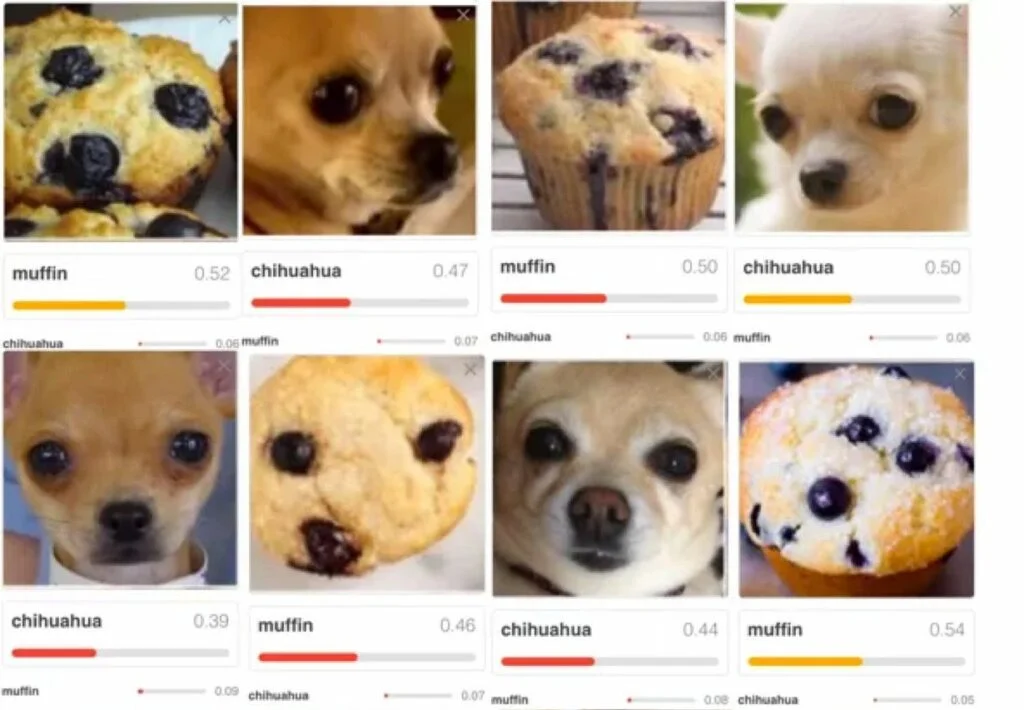
From Johner Institute
- Sets of sound waves that go together
- What does "Yes" sound like?
- What does "No" sound like?
- What do the numbers "0, 1, 2, 3, 4, 5, 6, 7, 8, 9" sound like?
- We've had "AI" for years:
- Speech-to-text: typing on phones, or talking to your Siri / Smart Assistant.
- Text-to-speech: Reading phrases out loud.
- Optical Character Recognition: Taking scanned books, studying the pixels, turning it into actual text in a text file.
- Recommendation Algorithms: You've watched Austin Powers 1 and Austin Powers 2. Perhaps the next movie suggested will be…
- Last decade, the machine learning around recommendation algorithms (whether for movie suggestions or auto-approving loans or ranking teachers) was under the umbrella of "Big Data", as the internet provides huge pipelines of data collection.
- Computers are MATH
2.3. AI in media is not realistic
For most people before the 2020s, the term "AI" was something from science fiction, and we have an idea of what we think AI would be like if it were real.
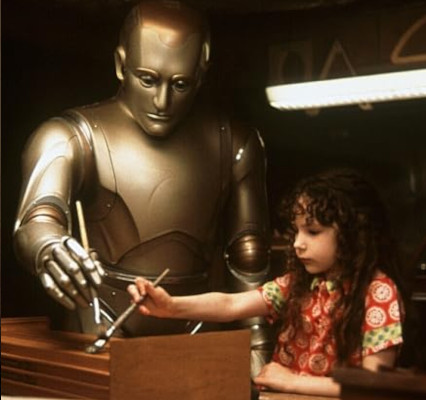
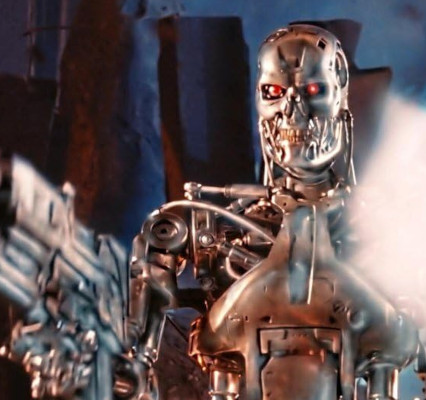

Images from IMDB
But how "AI" is presented in movies is not how real world computer programs labeled AI work, they do not have the same capabilities.
Computers Are Math - Machine Learning and the Large Language Models we see today are based on statistical probabilities - most likely word to come next, most likely pixel to come next.
People like to anthropomorphising things
- We give boats names, we speak to our pets, we might even thank our Roomba for its work.
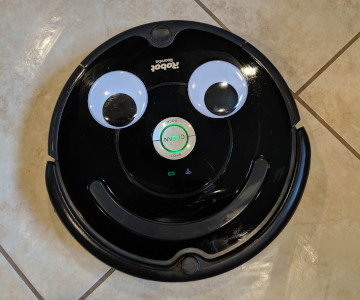
Image from hugelol.com
And we're good at seeing patterns


Chatbot AIs do not reason or make decisions.
2.4. "This is the future. There's no point in resisting."
We've seen similar hype before.
… This is the future.

From BizJournals.com
… Those who reject this are are going to get left behind.
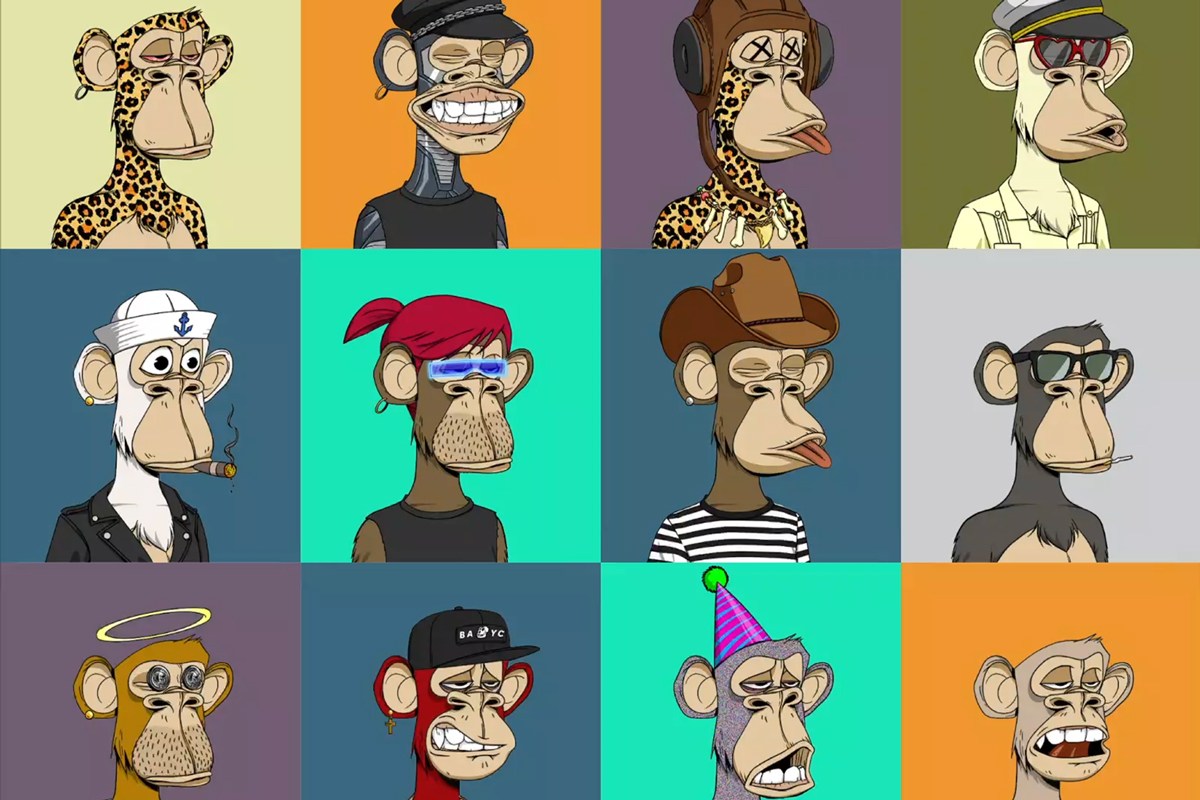
From Rolling Stone
- The hype around AI is similar to other 2010s-2020s grifts:
- Bitcoin
- NFTs
- The Metaverse
- Investors are always hungry to jump onto the next hype train in hopes of getting rich quick:
- After Fortnite and PubG there were SO MANY BATTLE ROYALE GAMES
- Mortgage-backed Securities (2008 financial crash)
- Dot Com Bubble (Some websites were good… but investors were handing money over to any "dot com" even if they had no real product)
- 1980s Video Game crash (too much slop)
- The California Gold Rush
- Tulip Mania
3. OK… So how about what is called "AI" these days?
3.1. LLMs and Generative AI
Large Language Models are a subset of machine learning where the system has been trained on language, such as text from books, captions from YouTube videos, posts on social media, stories on fan fiction websites, and so on.
The model is a LARGE set of probabilities around next-word prediction basically trained on the entire internet and whatever books have been scanned and OCR'd.
- Generative AI is related but tends to be used specifically in reference to the model generating content, such as text, images, or audio.
Like a 2000s Hoverboard…

Image from Walmart
… It is a product of cool new technology (a hoverboard certainly has interesting self-balancing technology), but it isn't what we had in mind from media…

Image from ABC News and IMDB
… And it doesn't actually hover.
- Further, GenAI/LLMs are not purely autonomous. These technologies heavily rely on humans to train, review, and answer prompts. Sometimes, it's really just a human.
3.2. What LLM-based AIs are good at
Large Language Models are good at being a statistical model of a language - how likely words, parts of words, and so on are to appear near other words and in the context.
This might make them good for…
- Grammar checking - does your sentence statistically match common usage/format of the langauge?
- Transcription - when converting audio to text, does the text generated statistically match common usage/format of the language? (Perhaps the "listening" model misheard a word, but the "language" model can guess what the closest correct word would be.)
- Natural Language interfacing - While not 100% perfect, these
models can be used to provide a "natural language interface"
(that is, using everyday English or whatever language) to interact
with a system instead of very rigid commands like
find . -name "*.txt" -type f, or the keyword-heavy way we were trained to search online like "best tacos kansas city open late".
3.3. What LLM-based AIs are NOT good at
Translation - Generative AI does not operate on lines of text 1:1 like a traditional software program might work with. Again, it's statistical text completion. Therefore, GenAI doesn't do a good job at translations because it adds additional stuff to the output.
Planning and advice - Generative AI does not reason and it doesn't "know" good choices from bad choices, so asking it for advice can lead to misplanning, to giving bad medical advice, and outright lies. Further the bots will say things wrong but very confidently, go along with what the user is saying, leading to delusions (or "AI psychosis") that the chatbot itself reinforces.
Mental health counseling - Chatbots are trained on all of the text of the internet. Fantasy stories, message boards, "Am I The Asshole?" question threads on Reddit, plus so much more. Again, these have a tendency to go along with what the user is saying, uncritically agreeing.
There is already a Wikipedia page on "Deaths linked to chatbots", with new news stories periodically coming out about teens and adults committing suicide after relying on chatbots.
Preparing legal documents - There has also been a lot of news coverage of judges having to deal with erroneous legal documentation with stuff like fabricated or misrepresented cases, false quotes, and more.
Writing code - I would argue that while an AI can generate a solution…
/**
 * Entry point to log all document tabs maintaining their nested tree hierarchy.
 */
function listAllDocumentTabsRecursive() {
    const doc = DocumentApp.getActiveDocument();
    const topLevelTabs = doc.getTabs();

    if (topLevelTabs.length === 0) {
        Logger.log("No tabs found in this document.");
        return;
    }

    Logger.log("=== DOCUMENT TAB HIERARCHY ===\n");

    topLevelTabs.forEach(tab => {
        processTabRecursively(tab, 0);
    });
}

/**
 * Helper function that processes a single tab and recursively traverses its children.
 *
 * @param {GoogleAppsScript.Document.Tab} tab - The current tab object.
 * @param {number} depth - The current nesting depth (used for visual indentation).
 */
function processTabRecursively(tab, depth) {
    const indent = "  ".repeat(depth);
    const prefix = depth > 0 ? "└── " : "";

    const tabId = tab.getId();
    const tabTitle = tab.getTitle();
    const tabType = tab.getType();

    Logger.log(`${indent}${prefix}Tab: "${tabTitle}"`);
    Logger.log(`${indent}    ID: ${tabId}`);
    Logger.log(`${indent}    Type: ${tabType}`);

    // Access content if it's a standard text tab
    if (tabType === DocumentApp.TabType.TEXT_TAB) {
        const textTab = tab.asDocumentTab();
        const characterCount = textTab.getBody().getText().length;
        Logger.log(`${indent}    Length: ${characterCount} characters`);
    }

    // Fetch child subtabs and recurse down
    const childTabs = tab.getChildTabs();
    if (childTabs && childTabs.length > 0) {
        childTabs.forEach(childTab => {
            processTabRecursively(childTab, depth + 1);
        });
    }
}
… with my experience, I can write the same thing but smaller and more readable, maintainable, and exactly within the scope of what I need …
    function Start() {
  // First, we need to get the list of all tabs in the document.
  // This should be recursive, so we get all sub-tabs within tabs.

  tabsList = []
  GetAllTabs( tabsList );
  Logger.log( `${tabsList.length} total tabs` );

  issuesList = [];
  for ( let i = 0; i < tabsList.length; i++ )
  {
    Logger.log( `Tab name ${tabsList[i].getTitle()}` );
      // ... etc ...
  }
}

// -----------------------------------------------------------------------------
// -- TAB GETTING CODE ---------------------------------------------------------

function GetAllTabs( tabsList ) {
  const thisDoc = DocumentApp.getActiveDocument();
  const topLevelTabs = thisDoc.getTabs();
  for ( let i = 0; i < topLevelTabs.length; i++ )
  {
    tabsList.push( topLevelTabs[i] );
    RecursiveGetAllTabs( tabsList, topLevelTabs[i] );
  }
}

function RecursiveGetAllTabs( tabsList, currentTab ) {
  tabsList.push( currentTab );

  let childTabs = currentTab.getChildTabs();
  for ( let i = 0; i < childTabs.length; i++ )
  {
    RecursiveGetAllTabs( tabsList, childTabs[i] );
  }
}
3.4. Bad actors of AI usage
Some things that AI happen to be "good" at, enabling bad actors to do harm to others, the information ecosystem, consumers, and more, include…
- Scams! Scams! Scams!
- CSAM
- Nonconsensual explicit material/deepfakes generation
- Surveillance
- Stalking / nonconsensual filming
- Slop! Polluting the information ecosystem
- False advertising using AI generated "photos"
4. Jobs and "AI"
- Have you noticed that the push to integrate AI into jobs seems
to come from the top-down?
- Why does C-suite and admin like the idea of AI? What are they being sold on?
- What is the end-game here?
- In software development, I've seen reports of AI-usage-quotas and leaderboards being implemented. But when usage is enforced and measured, people find ways to exploit or game the system.
- But more recently, companies are also reining in AI usage due to cost.
- These companies running large models are spending tons of money, investments in data centers are being made without guarantee that those data centers will be utilized.
- Who takes the blame when an AI tool fails?
- What happens to expectations of our productivity with AI as part of the puzzle? Will we all be overworked (even more) due to this "increase in productivity"?
- There are also reports that companies that cite AI as a reason for layoffs are just doing it to save face because it looks more "innovative" than just being
5. Students and "AI"
How do students use AI?
From Harvard Business Impact Education:
- Research // I would make sure to ask for sources and CHECK EVERY SOURCE.
- Answer questions instead of Google // Again - NEED SOURCES.
- Converting draft to polished script // I consider this now not the student's own work.
- Generating pictures for presentations // GenAI pictures make things look cheap.
- Tutoring, flash cards // The student isn't an expert and cannot verify accuracy of what a chat bot provides. This could lead to learning misinformation.
Coding assistant // Students need to know the foundations of the language and computer science, and especially early on shouldn't rely on AI tools to write code.
- From PISA 2025 Results, OECD
To summarize text // This shouldn't be used as a replacement for actually reading the text; if you're going to use AI to summarize text, it should be more for finding information you've previously encountered.
To create drafts for writing // Drafting a work is an important part of the thinking process.
PISA data show that students who use AI for specific schoolwork tasks, such as summarising texts, drafting or conducting research, attain lower scores in science than students who do not use AI. In these scenarios, students who do not use AI outperform those who do, on average, by around 20 points – equivalent to being around one year of schooling ahead of their peers. However, weekly users of AI for general purposes have similar performance outcomes to non-users. Students who regularly use AI for general purposes, and have learning opportunities at school to develop AI literacy skills, tend to have slightly higher scores in science. However, these opportunities are more common among socio-economically advantaged students, risking a growing AI divide.
6. Should you use "AI" in your daily life?
6.1. Things to keep in mind when considering whether to use AI
For anybody…
Do you want to rely on proprietary systems owned by big tech? - There are Open Models, but the average everyday user is using something from OpenAI, Anthropic, Microsoft, Google, Meta, or Snapchat.
These companies could scrap their products (Sora is already defunct). Do you want to rely on a product that might go away or change pricing models to be prohibitive?
Are you ready to double-check everything that comes out of generative AI and not just try to offload your work to it? It's not just a "set it and forget it" sort of thing. It generates text, and then you have to pair down what is generated, double-check facts and sources, etc.
What do you want to use it for? - Are there non-AI software tools that can be used instead? Could your approach or process be made better instead?
- Are you willing to deskill in an area when you offload the task elseware? - Do you wish to have mastery over a content area, process, or skill? Are you okay with your existing skills around that item becoming worse from passing it off elseware?
7. JCCC's AI certificate
7.1. AI certificate
The Applied Artificial Intelligence Certificate prepares students to design, build, and support AI-enabled solutions. Designed for career starters and professionals seeking to upskill, coursework progresses from programming fundamentals, elementary statistics, and AI essentials to intermediate Python and machine learning. Advanced applied topics include database management, natural language processing, and computer vision. The certificate gives employers tangible evidence of applied AI competencies and provides a strong on-ramp to further study in computer science, data science, or related fields.
- CS 134: Programming Fundamentals
- MATH 161: Elementary Statistics
- CIS 120: AI Essentials
- DS 270: Introduction to Machine Learning
- CS 202: Concepts of Programming Algorithms with Python
- NEW: Artificial Intelligence and Ethics
- CIS 260: Database Management
- NEW: Introduction to Natural Language Processing
- NEW: Introduction to Computer Vision
7.2. General AI class
- Using chatbots and such. (I was having trouble finding my department's emails about it. :)
8. See also
News
- 404 Media - Lots of reporting on tech-based news, including AI and surveillance.
YouTube videos
- MarI/O - Machine Learning for Video Games (5 minutes)
- Easy Way to Stop Dangerous AI - No, Really - Internet of Bugs (17 minutes)
- The Future is a Dead Mall - Decentraland and the Metaverse, documentary by Folding Ideas (2 hours)
- Line Goes Up - The Problem with NFTs, documentary by Folding Ideas (2 hours)
Various sources
Recommended books